

Between Spain & Portugal
I copy here the beginning of the entry for 'Hispania' in the English Wikipedia:
Hispania was the Roman name for the Iberian Peninsula and its provinces. Under the Republic, Hispania was divided into two provinces: Hispania Citerior and Hispania Ulterior. During the Principate, Hispania Ulterior was divided into two new provinces, Baetica and Lusitania, while Hispania Citerior was renamed Hispania Tarraconensis. Subsequently, the western part of Tarraconensis was split off, first as Hispania Nova, later renamed "Callaecia" (or Gallaecia, whence modern Galicia). From Diocletian's Tetrarchy (AD 284) onwards, the south of remaining Tarraconensis was again split off as Carthaginensis, and probably then too the Balearic Islands and all the resulting provinces formed one civil diocese under the vicarius for the Hispaniae (that is, the Celtic provinces). The name Hispania was also used in the period of Visigothic rule.
![HISPANIA
Gallaecia
Tarraconensis
Lusitania
Cartaginensis
0 ~
TERE)
Baetica
Mauretania
LG I=TF]
Provincia administrativa de la Hispania
romana tras la reforma diocleciana.](https://contents.bebee.com/users/id/782114/article/between-spain-portugal/_19d1861a-950.webp)
And now, I copy the beginning of the entry for 'Iberian Union' in the same source:
The Iberian Union was the dynastic union of the Kingdom of Portugal and the Spanish Crown that existed between 1580 and 1640, and which brought the entire Iberian Peninsula, as well as Portuguese overseas possessions, under the Spanish Habsburg kings Philip II, Philip III and Philip IV. The union began following the Portuguese crisis of succession and the ensuing War of the Portuguese Succession and lasted until the Portuguese Restoration War in which the House of Braganza was established as Portugal's new ruling dynasty.
The Habsburg king was the only element that connected the multiple kingdoms and territories, ruling by six separate government councils of Castile, Aragon, Portugal, Italy, Flanders, and the Indies. The governments, institutions, and legal traditions of each kingdom remained independent of each other. Alien laws (Leyes de extranjería) determined that a national of one kingdom was a foreigner in all the other kingdoms.
Well, as we can see, it seems that we Spanish and Portuguese people are more than neighbors. We share a common geographical placement and history, and I would say more than that. We even share our blood. From my point of view, we are a kind of brother countries.
 |
| 'Nós e a Europa' (2001) |
In my case, I was born Spanish, but I have been to Portugal several times since I first went there in the year 2004 during an Erasmus scholarship. I've recently read the book 'Nós e a Europa ou as duas razões' by Eduardo Lourenço, and I would like to share some ideas that this reading has brought to my mind.
I know many schools here in Spain have exchange programs for their students with other countries like France, Italy, the UK, and Ireland, among others. But it’s pretty challenging to find a school that has an exchange program to take interested students to know Portugal and study there. Why?
Well, in my opinion, one of the reasons is that Spain and Portugal have been turning their backs on each other for many years. After the Iberian Union years, other great world powers entered the action, and we became a kind of rivals. Since then, Portugal has been more influenced by the UK, and Spain has been more influenced by France.
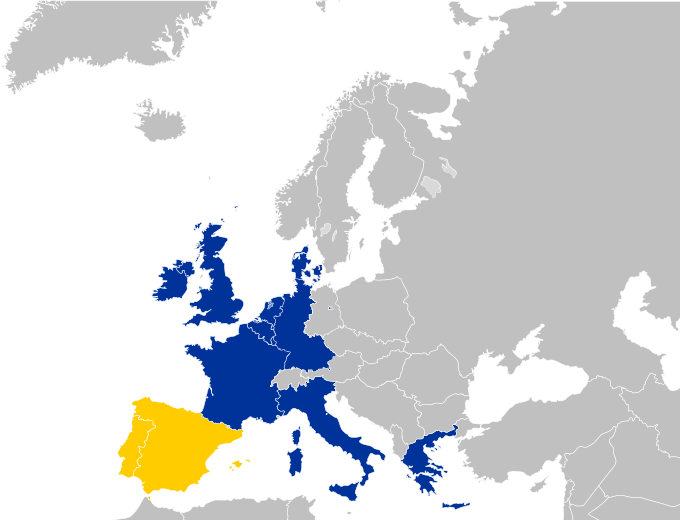 |
| European Union Enlargement (1986) |
I reckon there is no need to be enlightened to realize that what Spain exceeds is just what Portugal lacks, and what Portugal exceeds is just what Spain lacks, too. Although there are always exceptions, from my point of view, some positive features of Spaniards are, for example, our optimism and our simplicity. And some positive features of Portuguese people are, for example, their union as a people and their versatility. All these features are complementary. Both countries keep many other common features, such as our bravery and capacity to overcome adversity. But we have been turning our back on each other as two jealous brothers for many years... I don't know how long it will take us to reach adulthood. On the 1st of January 1986, Spain and Portugal became members of the European Union. This Union offers us a framework in which we can overcome all these quarrels while always respecting the identity of each people.
I would like to add here that both Portuguese and Spanish people have a lot to learn from each other, and there are many things we can improve. Our survival will largely depend on the success of this mission.
| 'The Mission' (1986) |
Artículos de Pablo Gómez Abajo
Ver blog
Our work 'A Tool for Domain-Independent Model Mutation' is now available online. Thanks to my superv ...

The haunted time travel of the mad candidate to Knight Templar · In the 12th Century, deep in Old Ca ...

Todo inflamiento de pelotas tiene un límite. Creo que debo agradecer que, por lo visto, en otras épo ...
Te pueden interesar estos trabajos
-
Buscamos un People & Culture Partner para unirse a nuestro equipo en Vigo. Trabajará mano a mano con nuestra VP de Personas y Cultura para UKI y Europa Continental, apoyando a los equipos en España y Portugal. · ...
Vigohace 1 mes
-
Formar parte de un proyecto global en una compañía líder donde podrás colaborar con equipos internacionales y acceder a herramientas punteras. · Garantizar la fiabilidad y consistencia de la información para decisiones estratégicas. · ...
Zaragozahace 1 mes
-
Se busca un becario para apoyar en la gestión de promotores en tiendas y en la gestión del merchandising. · ...
Barcelonahace 3 semanas
Comentarios